What initial impulses, experiences, or influences led to the creation of your piece on RESURGENCE VOL. 3?
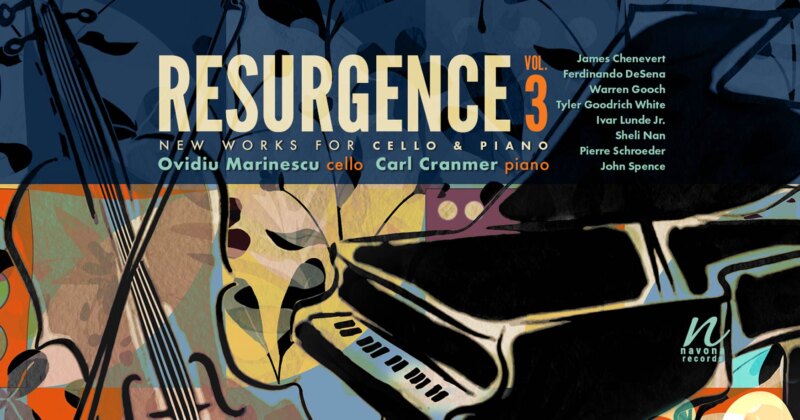
We recently connected with the composers of RESURGENCE VOL. 3 to learn more about the inspirations, realizations, and processes behind their work. Read on for a deep dive into the creative minds of Ivar Lunde Jr. (IL), Sheli Nan (SN), Ferdinando DeSena (FD), James Chenevert (JC), and Warren Gooch (WG).
What initial impulses, experiences, or influences led to the creation of your piece on RESURGENCE VOL. 3?
IL: I have always liked to compose music for friends. When I retired from my university position it gave me more time. A performance was not expected, however. It felt comforting to write for people with whom I had worked. Cellist Laura Handler was my inspiration this time. We had performed many concerts together, both with the Lyra Baroque Orchestra and our own ensemble Les Favorites. The result was Diversions for cello and piano.
SN: My piece Johann’s Hollow is from a fairy tale that I wrote about Death. Death stealthily creeps up on a darling little witch and we experience her fright as she does her best to shield herself. Death, in the shape of a cellist, takes this task as his right and the little witch dies. 9th Life, for solo piano, is another moving musical story (true) about two teenage girls who break a window on the train to Auschwitz Concentration Camp and escape to freedom.
What draws you to the cello-piano duo as a medium for expression?
FD: Being a keyboard player myself, I can write with intelligence for the piano. Therefore I’m less likely to write something that is impossible. There are other accompanying instruments that would also pair well with the cello: harp, vibraphone, marimba et al., but piano has an advantage in range and dynamic contrast and control. Besides it is the classic pairing for a solo “sonata.”
JC: Since some of my piano students also play another instrument, I like to compose or arrange works for piano and one or more instruments which we can then play together. I love the sound of the cello and I enjoy combining it with the piano due to the cello’s excellent projection, distinctive timbres in low, middle, and upper ranges, expressive capacity, and agility. It is one of the most frequently encountered “second” instruments among my piano students, along with the violin and the flute.
WG: I have always been drawn to the wonderfully rich tone quality of the cello. The instrument is so incredibly versatile and has such an expansive range. In many ways, it seems to mirror the human voice in its lyric and dramatic qualities. I would list the Italian composer and cellist Luigi Boccherini as one of my favorites, in no small part because of what he was able to accomplish in exploring the rich sonic possibilities of the instrument. As for the piano, it is potentially a keyboard orchestra. Together, these two instruments have exceptional sonic capabilities, and I have enjoyed exploring some of those capabilities in this work. Pairing these two instruments was perfect in that it allowed me to express the atmospheres and moods I wanted to incorporate in the piece, which covers a fairly wide range of material in a relatively short time span.
This album emphasizes music’s ability to capture profound emotions. What emotional or experiential space do you hope listeners enter while hearing your piece?
SN: When brilliant musicians perform this music we all are moved to heartfelt sadness. We become ever more grateful for this life we have.
FD: The very emotional expressions for which I chose the cello: pathos, nobility, tranquility, transparency.
JC: I always enjoy hearing listeners’ responses to music, including similarities and differences among individuals to a given composition or performance. Part of the magic of music is its ability to elicit responses or interpretations which differ from person to person, just as performances of a given composition can differ based on the interpretive choices by different performers. With Bourrée, I was trying to capture emotions and depict my own experience in this piece. Qualities or emotions which I consciously invoked in composing the piece include beauty, tranquility, nostalgia, reassurance, and joy. I was struck by the astute comment of cellist Ovidiu Marinescu upon first hearing Bourrée when I submitted it in response to PARMA’s Featured Recording Opportunity for this project: ”Bourrée is a gentle, friendly piece for a broad audience, which beautifully narrates a moment in time.”
What’s something you learned about your own music after hearing it recorded for this album?
IL: In recent years I have begun to study what I have written over time. Are there common traits, is there a pattern, a structure to my works? It appears that my compositional output can be divided into three periods, the early naïve and very tonal writing, the middle period heavily inspired by 12 tone formulas and a third, perhaps more realistic to who I am, a return to a more tonal environment. Every time I sit down to write I learn more about myself and my values. The turning point was when I was asked to write scores for the movie industry. Diversions for cello and piano is one that is a return to a more tonal environment. The more flowing lines of the first section are offset by high rhythmic energy in the latter part.
WG: The recording session was a wonderful experience. I was amazed at how effortlessly the musicians negotiated the technical and ensemble challenges present in the piece. As I was the pianist at the premiere performance, I know first-hand these challenges are not insignificant. I was even more delighted at how quickly they “got” the piece and went far beyond the notes to capture the essence of the music. For me, this was self-affirming, as it was my hope that others would understand the emotional and dramatic qualities I intended to incorporate into the music.